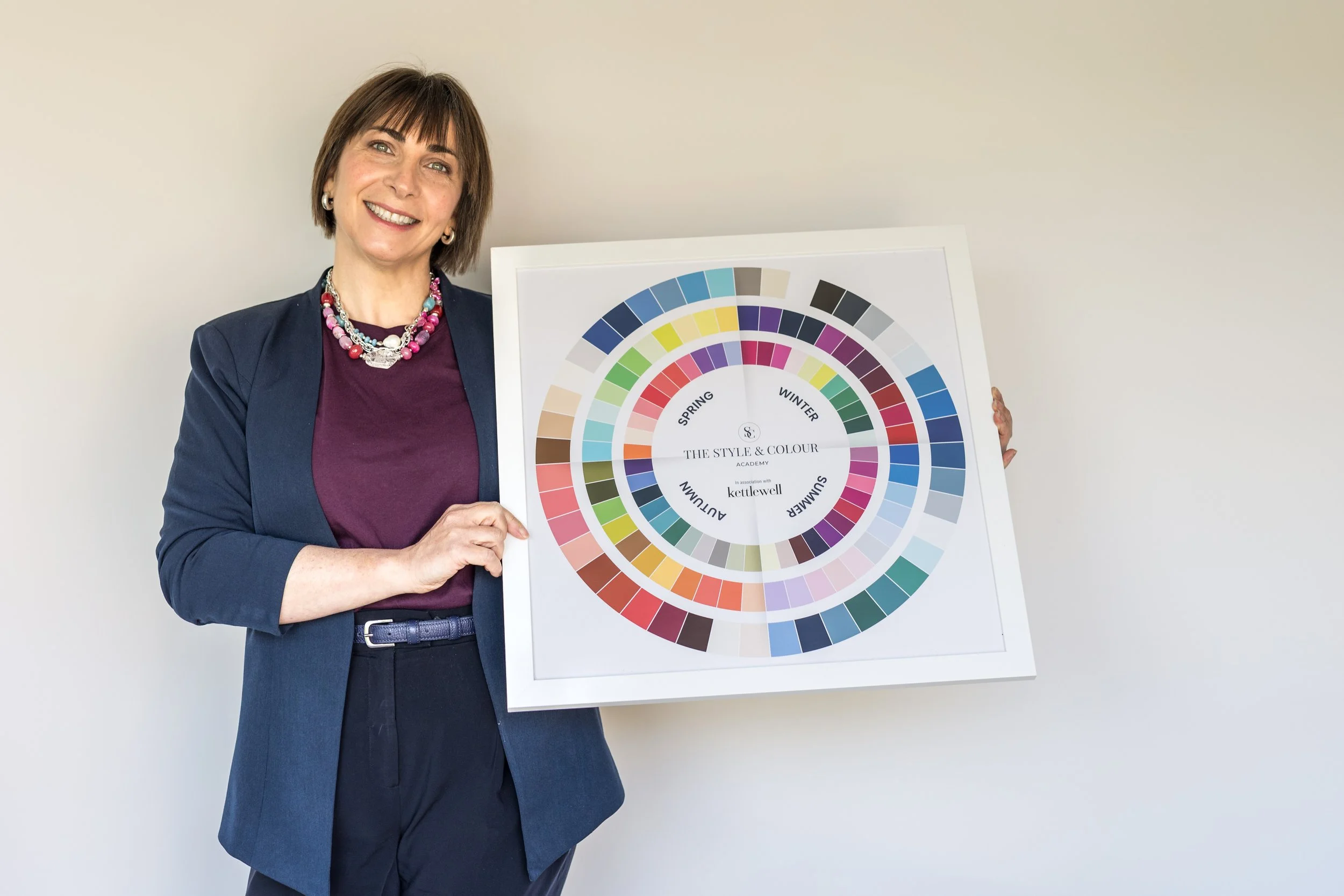
Photography by Kathryn Goddard
You’ve been told you’re a Soft Summer. Or a Blue Autumn. Or a Clear Winter. And you nodded along, took your little swatches home — and then spent the next three weeks falling down a rabbit hole of contradictory TikToks, Instagram reels and Reddit threads that left you more confused than when you started.
Sound familiar? You’re not alone. And more importantly — it’s not your fault.
The world of seasonal colour sub-types is genuinely confusing, partly because different training systems use different names for the same things, and partly because a lot of what’s circulating on social media is oversimplified, inaccurate, or generated by people (and algorithms) who don’t really understand it themselves.
Let me cut through the noise.
The four seasons — the foundation of everything
Before we get to sub-types, it helps to understand the foundation they’re built on.
Seasonal colour analysis starts with four main seasons — Spring, Summer, Autumn and Winter. Each one describes a broad category of colouring based on three key factors: hue, value and chroma. Hue (Temperature) refers to the undertone of your skin and natural hair—specifically whether your colouring leans Warm or Cool. Value (Depth)measures the lightness or darkness of your overall appearance, ranging from Light to Dark/Deep and how much contrast you have in your features. Chroma (Clarity) describes the purity and intensity of a colour, measuring how Bright/Clear or Soft/Muted your features are. These three facets are mixed and matched to determine your dominant seasonal palette. From these 4 dominant palettes, these 3 facets are then used to create the 12-season or 16-season systems, resulting in sub-seasons (like Soft Autumn, Cool Summer, or Bright Winter)
Spring is warm toned, light to medium value and fresh, clear, golden.
Summer is cool toned, light to medium value and soft, muted, delicate.
Autumn is warm toned, medium to deep value and rich, earthy, soft.
Winter is cool toned, medium to deep value and high contrast, clear, bold.
Most people who’ve taken an online quiz will have been given one of these four. That’s a useful starting point. But it’s a broad one — a bit like being told you live in the North of England without knowing whether that means Manchester or the Northumberland coast. Both are north. The detail matters.
What sub-types actually are
Sub-types exist to give you that detail.
Within each of the four seasons, there are variations — people whose colouring sits slightly differently within their season. A Spring might have particularly warm, golden tones. Another Spring might have clearer, brighter colouring. Both are Spring. But what looks best on each of them differs in the nuance.
That’s what a sub-type captures. It’s not a different season — it’s a more precise location within your season. Think of it as your postcode within your county.
Your sub-type is your “home base” on the colour wheel. It tells you where you’re most at home — not where you’re confined. Understanding it gives you the freedom to dress with intention rather than guesswork.
Why the terminology differs depending on who you ask
Here’s where a lot of the confusion comes from.
Different colour analysis training systems use different names for their sub-types. The system I’m trained in — the SCA method using Kettlewell drapes — uses descriptive terms that map directly to the qualities of your colouring. Other systems use entirely different naming conventions for what are, at their core, the same distinctions.
So if you’ve been told two different sub-type names by two different analysts, it doesn’t necessarily mean one of them is wrong. It may simply mean they were trained in different systems, using different maps of the same territory.
The underlying principles are consistent across all reputable systems: warmth, depth, clarity and contrast. The names change. The colour wheel doesn’t.
The 16-season system explained simply
The system I work with identifies 16 sub-seasons — four within each of the main seasons. Here’s how they break down:
Seasonal Sub-types
Spring: True Spring, Warm Spring, Light Spring, Clear Spring
Summer: True Summer, Cool Summer, Light Summer, Soft Summer
Autumn: True Autumn, Warm Autumn, Deep Autumn, Soft Autumn
Winter: True Winter, Cool Winter, Deep Winter, Clear Winter
Each True season sits at the heart of its season — the most classic expression of it. The other three sub-types lean in a particular direction: warmer, cooler, lighter, deeper, clearer or softer than the True centre.
A Soft Summer, for example, sits at the boundary between Summer and Autumn — cooler than an Autumn, but with more muted, softer depth than a True Summer. A Clear Spring sits closer to Winter — Spring’s warmth with a crispness and brightness that True Spring palettes don’t always capture.
Understanding where your sub-type sits — and which neighbouring season it leans towards — is what allows you to shop intelligently in the grey areas. And there are always grey areas.
Your palette: 33 colours, not 8
This is the part that gets lost most often — particularly on social media.
Photo by Andy Brown on Unsplash
Your full seasonal palette contains roughly 33 colours (depending on the system analysed - some tonal systems have 42 colours). Your sub-season sits within that, and contains around 8 to 10 colours that represent the most precise expression of your colouring. But — and this is important — those 8 to 10 colours are not your whole world. They’re your home base.
Wearing only your sub-season colours is like only ever visiting the street you grew up on. You know it best. You’re most comfortable there. But you have an entire neighbourhood to explore — and beyond that, adjacencies into the next area that may still suit you well.
If you have your colours analysed with me, your full seasonal palette gives you 33 colours to work with. And from there, depending on where you sit on the colour wheel, you can also explore adjacent sub-seasons — colours from neighbouring seasons that share enough of your underlying characteristics to work well on you. For example, I’m a Cool / Deep Summer so wear the whole Summer palette but also “borrow” some colours from the Winter palette that harmonise with my features.
Anyone telling you that you can only wear your 8 sub-season colours is giving you an unhelpful rule that is too restrictive, doesn’t make sense and that isn’t the point of colour analysis, which is to give you greater freedom of choice!
What to do if you have a sub-season label but no real explanation
This is more common than it should be. Women come to me having been given a label — sometimes years ago, sometimes from an online quiz, sometimes from a session that didn’t go deep enough — with no real understanding of what it means or how to use it.
If that’s you, here’s where to start:
• Identify whether you are “warm” or “cool” and what is your main season first — Spring, Summer, Autumn or Winter. That’s your broadest orientation and the most important thing to understand. You can explore and wear ALL of the colours within your seasonal palette, some will be more wow than others, but if in doubt, focus on this first.
• Recognise that the sub-type you’ve been given just orientates you within that season. Understand in which direction it leans — warmer, cooler, lighter, deeper, clearer or softer than the True centre.
• Always use your full seasonal palette as your shopping guide — not just your sub-season colours.
• If you’re still confused, or if you’ve never had a proper in-person analysis, I’d recommend you booking an in-person analysis with a credible Image Consultant. That’s the single most useful thing you can do. A good analyst won’t just give you a label or put you in a box— they’ll make sure you leave understanding where your home base is and how to use it.
Colour analysis should leave you feeling clearer, not more confused. If yours didn’t — or if you’re still piecing it together from social media scraps — you deserve better than that and I can help.
→ Book a free discovery call
Read more in this series:
• Read first: What is colour analysis?
• Read next: Does my colour season change when my hair goes grey?
• Follow along on Instagram for colour analysis content, style tips and a healthy dose of honest opinion
Emma Benjafield is a trained colour and style consultant working with midlife women across the UK. She uses the 16 sub-season method and works in person only for colour analysis consultations.