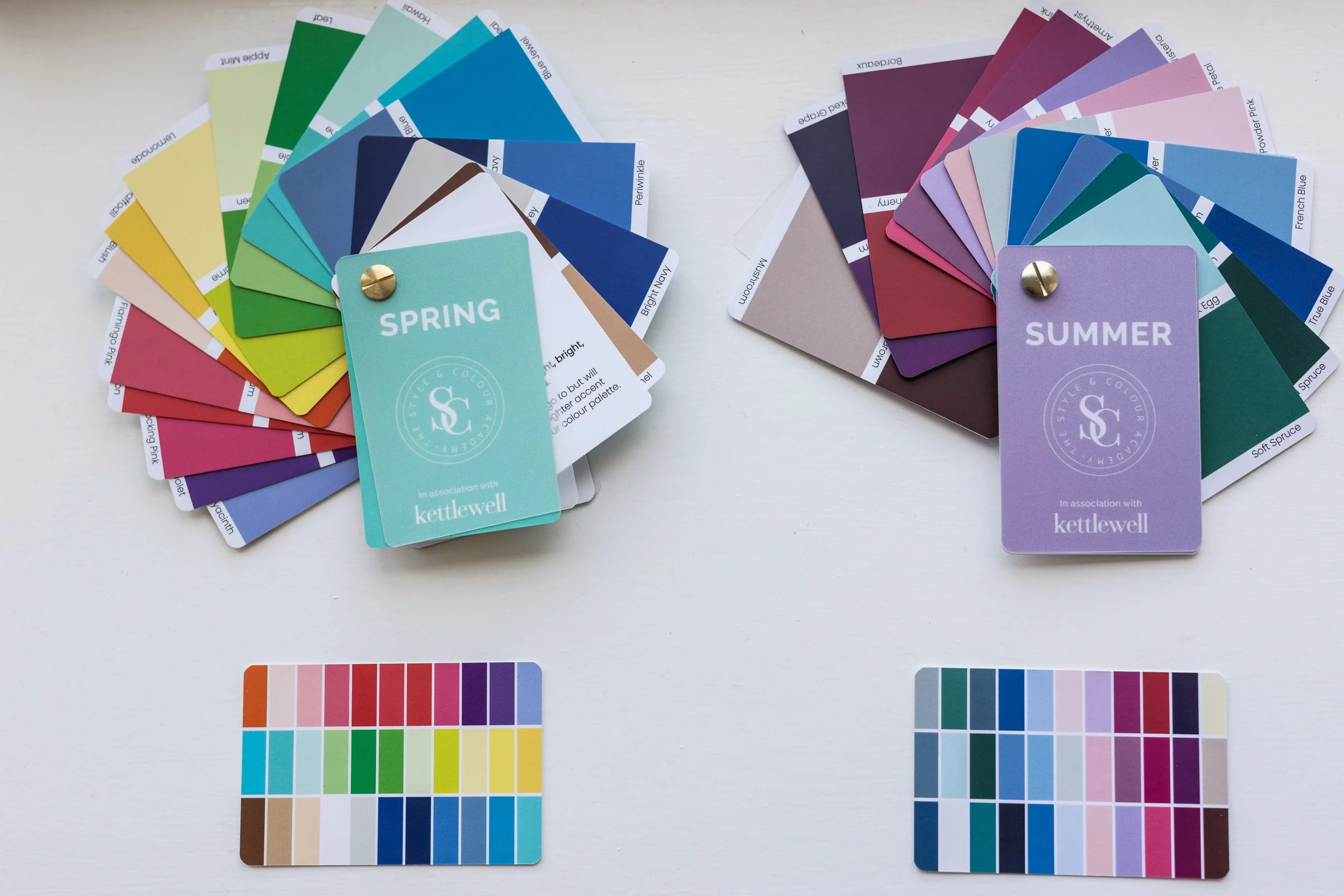
Photography by Kathryn Goddard
You’ve probably heard the term. Maybe you’ve seen it all over Instagram, taken an online quiz, or had a friend come back from an appointment raving about her ‘season.’ But what is colour analysis, really — and is it actually worth your time and money?
Here’s the honest answer. Colour analysis is one of the most useful tools I know for helping build confidence and transform the way you look. Not by following more rules. Not by buying a whole new wardrobe. But by understanding, finally, why some colours make you look tired and others make you look like yourself.
Let me explain how it works.
What colour analysis actually is
Colour analysis is the process of identifying which colours work in harmony with your natural colouring — your undertone, your skin tone, your hair, your eyes — and which ones work against you.
The result is a personalised colour palette. Not a rigid list of eight to ten colours you‘re “allowed” to wear. A palette — a whole world of shades, tones and combinations that genuinely suit you, combined with the knowledge to use it.
The system is based on seasons. Most people have heard of the original four — Spring, Summer, Autumn, Winter. A more nuanced approach works with 12 or 16 sub-seasons, each one more specific to you. Your season tells you not just which colours work, but why, by identifying whether you have a warm or cool undertone as a starting point — and that understanding is what makes it genuinely useful rather than just another rule to follow.
Why undertone is the thing that explains everything
The foundation of colour analysis is undertone. And it’s based on science. At its most technical, it’s determined by the specific type and amount of melanin (skin pigment) in your top skin layers, mixed with the colour of blood flowing through your capillaries. Your skin acts like a translucent filter. When light hits your skin, the light wavelengths reflect off the pigments and blood vessels just beneath the surface. If your skin filters out certain wavelengths, it creates a subtle colour cast – cool pink, warm golden or neutral, independent of the actual tone of the surface of the skin that you can see. It’s this subtle warmth or coolness beneath your skin that determines, at the most fundamental level, which colours will make you look alive and which ones will quietly drain you.
This is also why online quizzes and apps can only take you so far.
Undertone cannot be accurately read on a screen. An algorithm can’t see how a warm gold reacts against your skin in natural light. Your phone camera can’t correctly read the subtle blue-grey in your eye. And you genuinely cannot assess your own undertone in a mirror — you don’t have the reference points.
I don’t say this to be snobbish about apps. Quizzes are a brilliant starting point — they get you curious, point you in the right direction, give you a framework to think about. But they have a ceiling. And the ceiling matters, because if you’ve been given the wrong season by an AI, you could spend years buying colours that don’t quite work and not knowing why.
A trained colour analyst, working with you in person, in natural light, with physical fabric swatches — that’s what gives you an accurate result. Not because we’re precious about it. Because the information genuinely requires trained eyes and real-world conditions to read correctly.
What happens in a colour analysis consultation
If you’ve never had one, here’s what to expect.
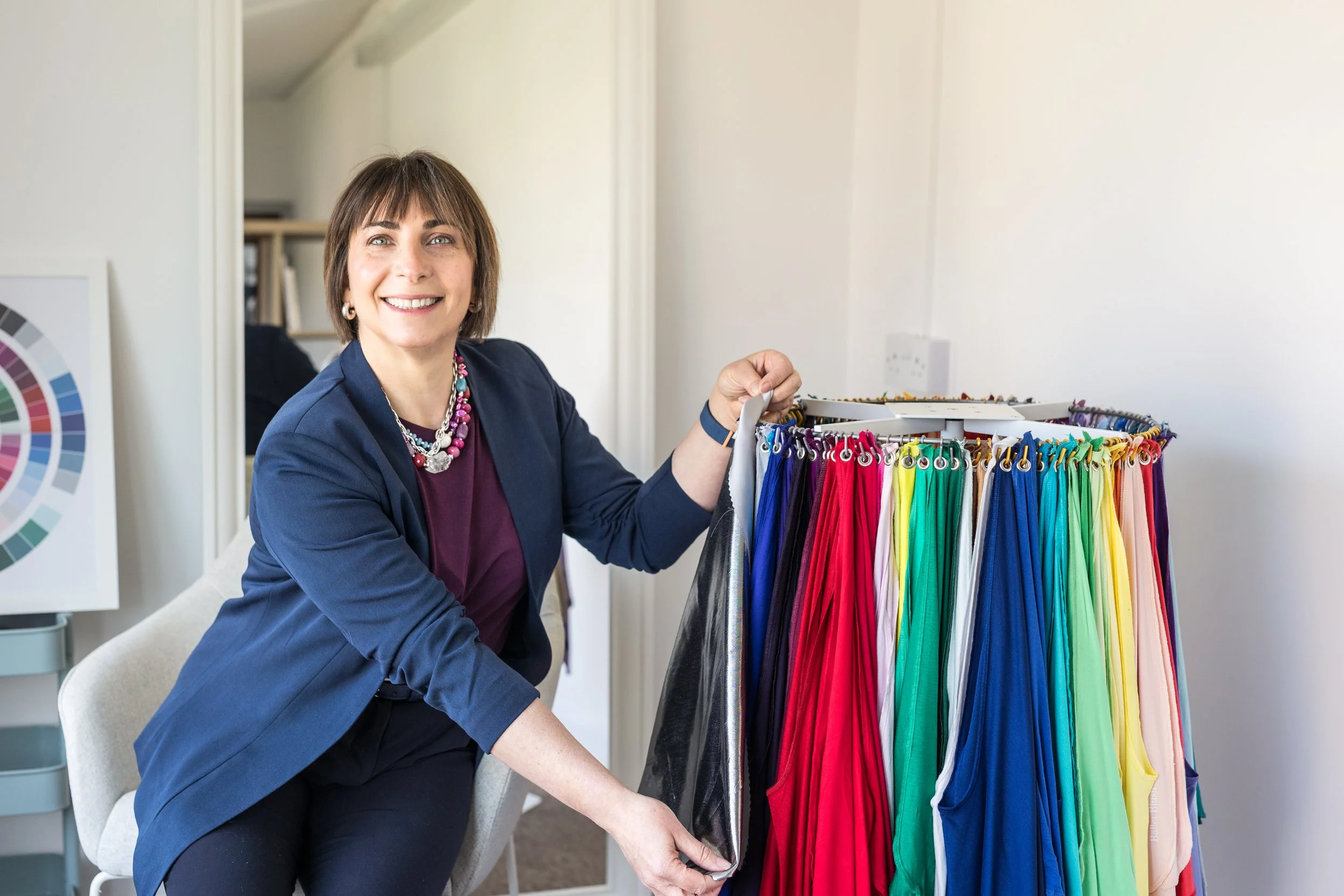
Photography by Kathryn Goddard
You’ll sit in natural light — ideally near a window, away from artificial lighting that skews the result. Daylight lighting may be used to enhance this natural light. Your analyst will drape a series of fabric swatches around your shoulders, one at a time, and observe how your skin, eyes and hair respond to each colour.
Some colours will make your skin look clearer, your eyes brighter, your face more alive. Others will create shadows, emphasise fine lines, or make your complexion look flat. The difference is often instant — and frequently surprising. Colours you’ve always loved might not love you back. Colours you’d never have picked might be exactly right.
By the end of the session, you’ll know your undertone – whether you are warm or cool – and will usually have your confirmed season, and sub-season within that. Your analyst will then go through your personal colour palette with you and ensure that you completely understand how to use it in the real world. That last part really matters. Understanding the why means you can apply it yourself — shopping, getting dressed, choosing makeup — rather than just following a rigid set of rules.
Colour analysis for clothes, makeup and beyond
The most obvious application for colour analysis is your wardrobe. Knowing your palette means you can shop with intention — looking for the right shade of navy rather than any navy, the specific greens that work rather than the ones that don’t. It transforms shopping from a guessing game into something much more purposeful, reduces wardrobe overwhelm by helping you build a curated edit that works together and makes getting dressed every morning simpler.
But it extends into makeup, accessories, and can even influence the colours you surround yourself with at home. Once you understand your palette, you’ll start to see it everywhere — and it changes the way you make decisions.
It also saves money. Significantly. When you stop buying things that look good on the hanger and start buying things that look good on you, the return pile shrinks. The ‘never worn with the tags still on’ pile shrinks. Your wardrobe starts to actually work.
What colour analysis actually does for you
The benefits go further than most people expect:
• You make a stronger first impression. — People respond to you differently when your colours are working. You look more alive, more present, more like yourself.
• You spend less and wear more. — Knowing your palette means fewer wrong purchases, fewer returns, fewer tags still attached six months later.
• Getting dressed becomes easier. — Decision fatigue drops significantly when you understand what works and why.
• Your confidence shifts. — When you know you look good, you feel better, more confident, more you. It sounds small. It isn’t.
• Your wardrobe starts to coordinate itself. — Everything in your palette works together, which means more outfits from fewer pieces.
• It extends beyond clothes. — Makeup, hair colour, accessories, even your home. Once you have the knowledge, it changes how you make decisions everywhere.
What colour analysis is really about
Here’s what I want you to take away from this.
Colour analysis is not about restriction. It’s not about being handed a list of colours and told that’s your lot. It’s not about rules.
It’s about understanding yourself well enough to make better decisions. Where your “home base” is on the colour wheel — and the freedom that comes with knowing where you can move from there.
Women come to me having spent years buying clothes that don’t quite work and not knowing why. They leave with clarity. That clarity is worth more than any number of perfectly curated flat lays on Instagram.
Quizzes, apps and at-home kits — what’s actually worth it
A quick honest guide:
• Colour analysis quizzes are a useful starting point, good for curiosity, not a substitute for the real thing. Take one, enjoy it, use it to start thinking about your colouring. I’d recommend the Colour Quiz on the Kettlewell Colours website as a good place to start (https://kettlewellcolours.com/pages/find-my-colours). Then follow up with an in-person analysis.
• AI colour analysis apps — don’t bother. They cannot read undertone accurately and their hit rate is terrible.
• At-home colour analysis kits — again, as a way of finding your season, the limitations are real — you can’t drape yourself objectively. Not worth spending the money.
The positives of the above are that they’ve brought colour analysis to a much wider audience and that’s genuinely brilliant. But if you want an accurate result — one that actually changes how you get dressed — a professional consultation is the only place to start.
How to find a colour analyst near you
If you’re in the UK and you’re looking for in-person colour analysis, look for analysts trained in a recognised seasonal method — the 12-season or 16-season system, or using the tonal system. Ask about their training, their process, and whether they work in natural light, in-person and with fabric drapes.
I offer colour analysis consultations in person, using the 16 sub-season method — the most nuanced approach available. If you’re curious whether it’s right for you, a discovery call is the best place to start. No pressure, just a conversation.
→ Book a free discovery call
Want to go deeper?
• Read next: What are seasonal colour sub-types? (The 16 seasons explained)
• Read next: Does my colour season change when my hair goes grey?
• Follow along on Instagram for colour analysis content, style tips and a healthy dose of honest opinion
Emma Benjafield is a trained colour and style analyst working with midlife women across the UK. She uses the 16 sub-season method and works in person only for colour analysis consultations.